
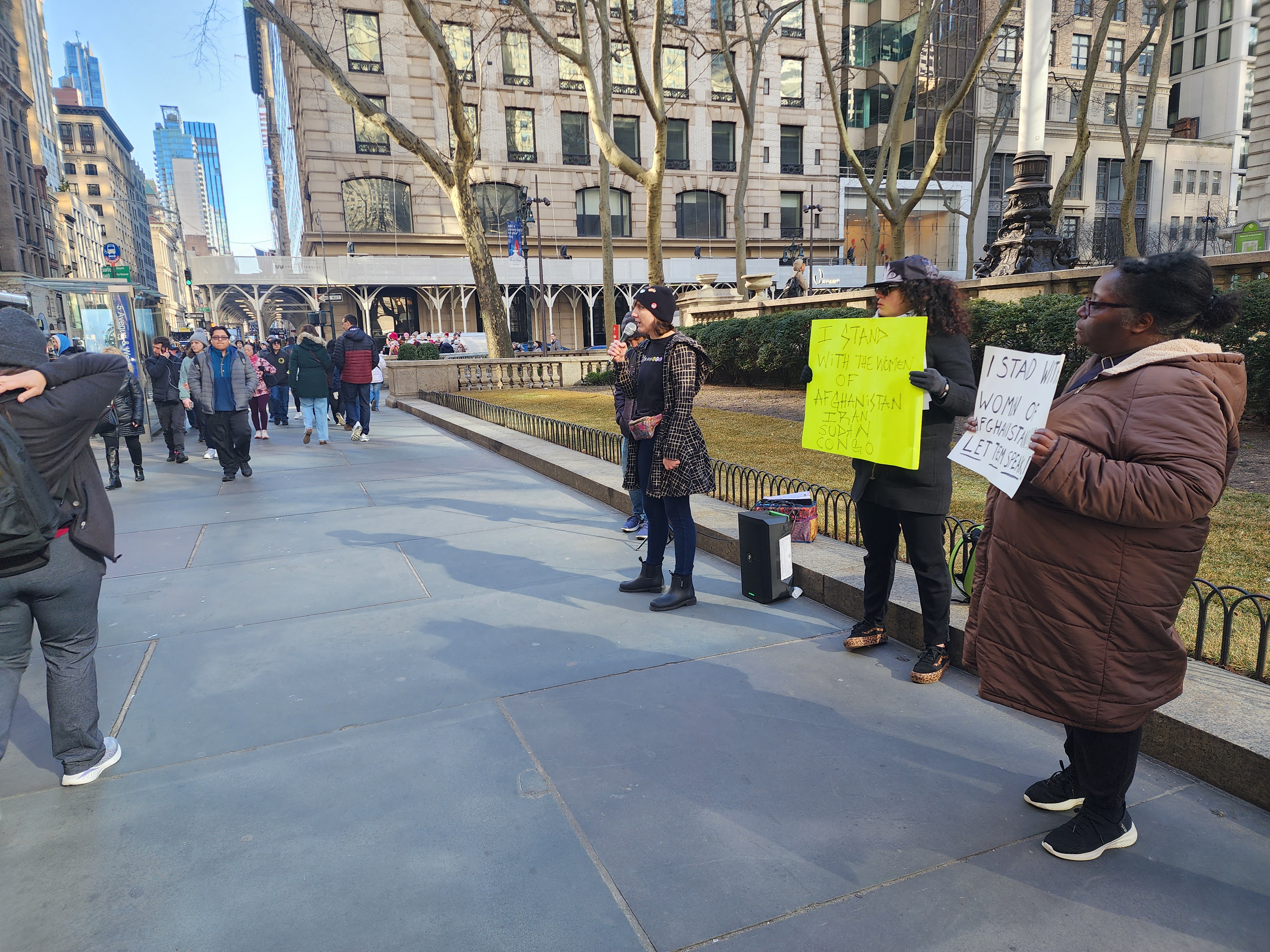
This International Women’s Day, ROAR Women NYC teamed up with Women’s Declaration International to center the plight of Afghan women and girls.

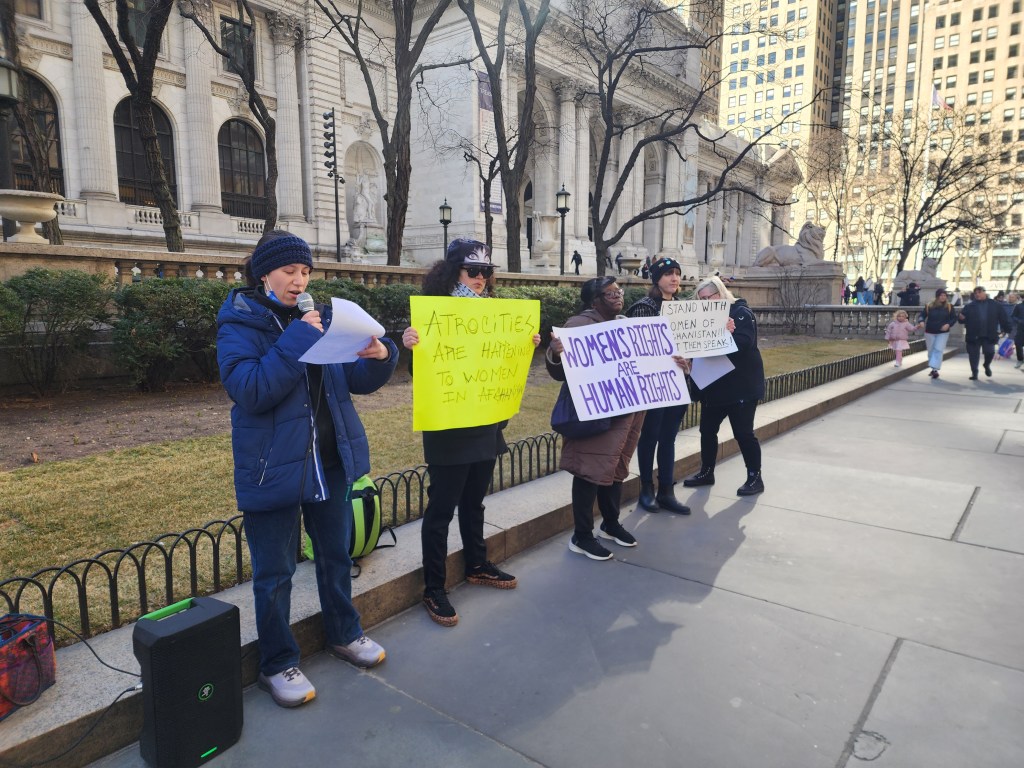
From a prime location in front of the iconic Bloomingdale Library in Bryant Park, thousands passed by as we read testimonies from female Afghan refugees detailing their experiences—their loss, their hope, and their struggle—under Taliban rule.
Below is our small but mighty group delivering the testimonies for 30 minutes, with references to relevant U.N. Commission on the Status of Women events and miraculous moments in feminist history.
One of the testimonies reads:
Afghan women have endured a lifetime of struggle. From the moment we are born, we face hardship, restrictions, and countless barriers. I want to share my story, my family’s struggles, and the experiences of Afghan women I know to show what life is like for us.
Every Afghan girl fights a difficult battle when she reaches her teenage years. She struggles between what she wants for her life and what her family, culture, and religion expect from her. A girl in Afghanistan rarely has the freedom to explore herself, her dreams, or her interests. Instead, she is forced to conform to strict traditions and social norms. She grows up in a society where her role is often limited to being a daughter, a wife, and a mother—without the right to choose what she wants for herself.
Now, imagine a woman who manages to fight against these barriers, overcome the hardships, and obtain an education. This is not common, and only a small percentage of Afghan women—those who lived in cities and had financial means or an educated male family member—were able to study. However, the majority of Afghan women, especially those in rural areas, lived through decades of war with no access to education, healthcare, or basic rights.
For over 20 years, these rural women were forgotten by both their own country and the world. No one fought for their rights. The violence, murders, and suffering they endured were never exposed. Their stories remained unheard. Many of them lost their husbands, fathers, sons, and brothers in the war, leaving them in grief and struggling to raise their children alone, without any financial or social support. They were trapped in poverty, unable to send their children to school or access medical care when they were sick.
When the Taliban took over Afghanistan in August 2021, Afghan women faced another tragic turning point. Those who had managed to become doctors, midwives, teachers, and NGO workers were forced to leave the country, abandoning the careers and dreams they had fought so hard for. Some were able to escape and settle in other countries, but only if they were lucky enough to receive support.
A large number of Afghan women, however, remain stuck in Iran and Pakistan, living in extreme poverty. They are refugees, waiting for an uncertain future, hoping to be resettled in a third country. But no one knows how long they will remain on waiting lists. Many have been forgotten, left in limbo without legal status, jobs, or hope.
Other Afghan women arrived in countries where they had once dreamed of studying and working, only to face new struggles. My sister is one of them. She was only 18 when she fled Afghanistan, hoping for a better future. But instead of finding opportunities, she faced endless hardships.
For four years, she was unable to stay in Spain because she had to take care of our elderly parents and grandmother. Since she could not work or support them, she left for Germany, believing she would find better opportunities there. But Germany denied her asylum under the Dublin Regulation, a law that prevents asylum seekers from applying in multiple European countries. Feeling hopeless and desperate, she attempted suicide, believing it was the only way to stay. She spent four months in the hospital before being deported—along with our 75-year-old grandmother, who suffers from serious health conditions.
My parents, who had already suffered through war, then spent four years in refugee camps, struggling to build a stable life. Meanwhile, my sister, with no support in Spain, returned to Germany. But instead of finding safety, she was arrested. Now, she has turned 21 in jail, with an uncertain future ahead.
Some Afghan women were luckier, like me. A few feminist women understood the struggles that Afghan girls face and helped me continue my education. Because of them, I was able to earn a master’s degree. But even now, I do not have work authorization in the United States. I cannot apply for asylum because I first applied in Spain—a country that promised to give me a new life but never provided the support I needed to survive.
Beyond my story, there are thousands of Afghan women who were born, raised, and died in war. Many never had the chance to receive an education. Some belonged to families where the men were Taliban fighters or soldiers who were either killed or injured in war. Their suffering has never been recognized.
Now, there is another generation of Afghan girls trapped at home. I recently spoke to my 12-year-old cousin in Afghanistan. She told me that she finished 6th grade, but now she can no longer continue school. She dreams of being like me, breaking the norms, moving to another country, living independently, and studying abroad. But she asked me, “How can I do it? How will I ever be able to become like you?” I had no answer for her.
The world has forgotten all of us. By putting sanctions on the Afghan government and refusing to recognize it, the international community is also cutting off support for the Afghan people. As a result, many families are now forced to sell their daughters as young as six or seven because they cannot afford to feed them. With men unable to provide financially, women are under extreme pressure. They face hunger, poor health, and abuse, yet no one speaks for them.
If the world does not support Afghanistan and does not rebuild its relationship with the country, the suffering of Afghan women will only get worse. When a country is left in isolation, it is the women who suffer first. With no opportunities, no economic growth, and no international engagement, men will put even more pressure on women. Women will continue to be the first victims of war, poverty, and oppression.
During the four years I struggled to study, I never felt peace or stability. I never had a moment where I believed I could settle down, have a home, or take care of my mental health. I had to make incredibly difficult decisions—ignoring my own well-being just to survive. This world has been cruel to Afghan women, and it remains cruel today.
This is the reality of Afghan women: A life of struggle, loss, and survival.
We’re so proud to have partnered with WDI USA to make this event happen, and of the work their volunteers have done to make the future that much brighter for Afghan women!
You can read more about WDI Afghanistan here—and also sign several petitions that support Afghan women, or support reputable organizations providing necessary humanitarian aid to the women and girls who have had their rights stripped away under Taliban rule. WDI USA is also hosting a webinar amplifying Afghan women’s voices on Saturday, March 22, at 2 PM EST. You are all invited to attend.
(If you’d like to see more pro-woman events in NYC, we invite you to support or join ROAR Women NYC. We’re small but mighty, and NYC’s best bet to restore it to its former status as a hotbed for women’s rights!)

Leave a Reply